Award Winning Self Catering Holidays In the Derbyshire Peak District





Browse through our blog posts to find out what life is like at Hoe Grange Holidays along with some great ideas for days out in the Peak District.
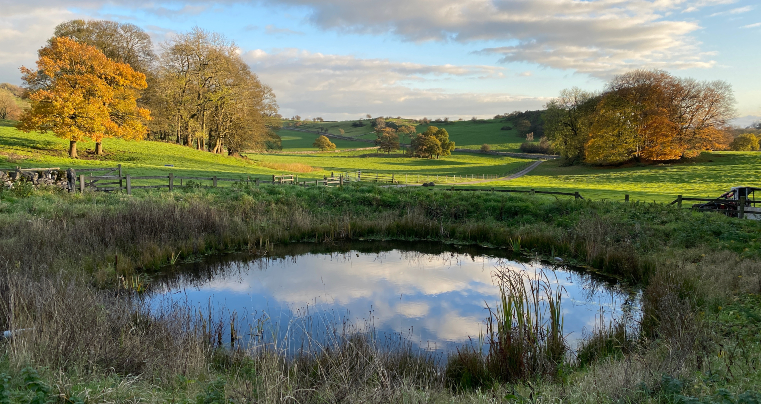
There’s something quietly magical about a dew pond. Set high on the hills, far from streams and rivers, these man-made pools once kept livestock watered long before mains supplies reached our fields. Today, they’re an important haven for wildlife.
Here at Hoe Grange, we’ve been working to restore one of our old, dried-out dew ponds, in conjunction with Derbyshire Amphibian and Reptile Group. It’s part of our commitment to caring for the land, protecting local wildlife and preserving the rural heritage that makes the Peak District so special.
If you’re staying with us, ask Farmer David to point you in the right direction, you can walk across the fields and see it for yourself.
Despite the name, dew ponds don’t actually fill from dew. These shallow, circular ponds were built near or on the top of hills to collect rainwater and snowmelt, providing an essential water source for livestock in places with no natural springs or streams.
Lined with puddled clay and topped with straw and a layer of large stones, they were cleverly designed to stay watertight and clean. Their wide surface area helped maximise rainfall collection while keeping evaporation to a minimum.
The exact origins of dew ponds are somewhat obscure, but they are believed to have been constructed as far back as the Neolithic period, around 4000 BC.
You’ll find dew ponds scattered across the White Peak and beyond. We’ve got six here at Hoe Grange farm; four hold water all year round. The one you will see in the farmyard is home to a rare colony of Great Crested Newts.
But one had dried up completely, cracked and overgrown, the stonework hidden beneath layers of grass. And we weren’t ready to let it disappear.
So with support from the Derbyshire Amphibian and Reptile Group (DARG), we decided to bring it back to life.
(Well, we didn't do it, a very talented young man call Danial Spencer did!)
The first job was to carefully dig out the pond, keeping its original size and shape.

The old limestone sets were carefully removed and saved for later.

Instead of the traditional puddled clay we laid a modern waterproof liner, followed by a fibre membrane.

Limestone grit was added next and carefully raked and graded by hand to avoid damaging the liner. Then, stone by stone, the sets were put back into place. Dew ponds are typically 3 to 15 meters in diameter and about one meter deep, at about 12 meters ours is a very large pond and quite deep, so this part took time and care.

To protect all that hard work, David added a clever post-and-wire fence: low enough to keep the cows out, but high enough so sheep can duck under and graze the edges.

"This pond has been dry for years," says David. “There’s something deeply satisfying about bringing back something that’s been part of this landscape for generations. This pond might look simple, but it’s taken weeks of work, and it’ll hopefully support wildlife here for years to come. It just feels like the right thing to do.”
While dew ponds were once essential farm infrastructure, they’ve become quiet wildlife havens in today’s landscape. The pond has already started to collect water, but it could take up to a year to fill fully. When it does, we hope it will become another precious habitat for Great Crested Newts, one of Britain’s rarest amphibians. Our work is supported by the Derbyshire Amphibian and Reptile Group (DARG), who also help maintain our existing newt pond in the farmyard. It was last cleared out in 2020 and they come once a year at night to count and record the number of newts.
To learn more about this kind of habitat restoration, or the amazing work done by DARG, you can visit Derbyshire Amphibian and Reptile Group.
Want to see the dew pond restoration for yourself while you’re here? Just ask David and he'll point you in the right direction. It’s a lovely walk from your cabin or pod, especially in the golden hour of evening when the sun dips low over the fields. Take a picnic with you and sit and admire the view!
You might spot buzzards, red kites, magpies, woodpigeons, hares and wildflowers including orchids along the way. And if you pause for a moment at the edge of the pond, you’ll see what we see: a quiet little triumph for nature.
We know that when you book a countryside escape, you’re looking for more than just a place to sleep. You’re choosing peace, fresh air, maybe a new experience or two and often, a sense that your holiday does a bit of good, too.
Restoring this Peak District dew pond is just one of the ways we try to tread lightly and care for this part of the world. At Hoe Grange, we believe that farming, holidays and conservation can all go hand in hand. Our next restoration project is going to be rebuilding the stone walls of the pinfold up by the High Peak Trail.
It’s about doing our bit to look after the land we love, share its stories, and create a space where people and wildlife can both feel at home.
If that sounds like your kind of place, we’d love to welcome you so book your eco stay today.
Felicity
 Lovely place to holiday near to interesting locations and easy access to the High Peak trail and Carsington Water. Part of a working farm with fresh produce to enjoy during... read more

 We've just returned from our second visit to Hoe Grange. The suggested riding routes with stunning scenery were enjoyed by my daughter and I while the menfolk were delighted with... read more
We spent four nights at Hoe Grange and had a lovely time. The location is fantastic and right next to the High Peak Trail. The cabin was very clean and... read more